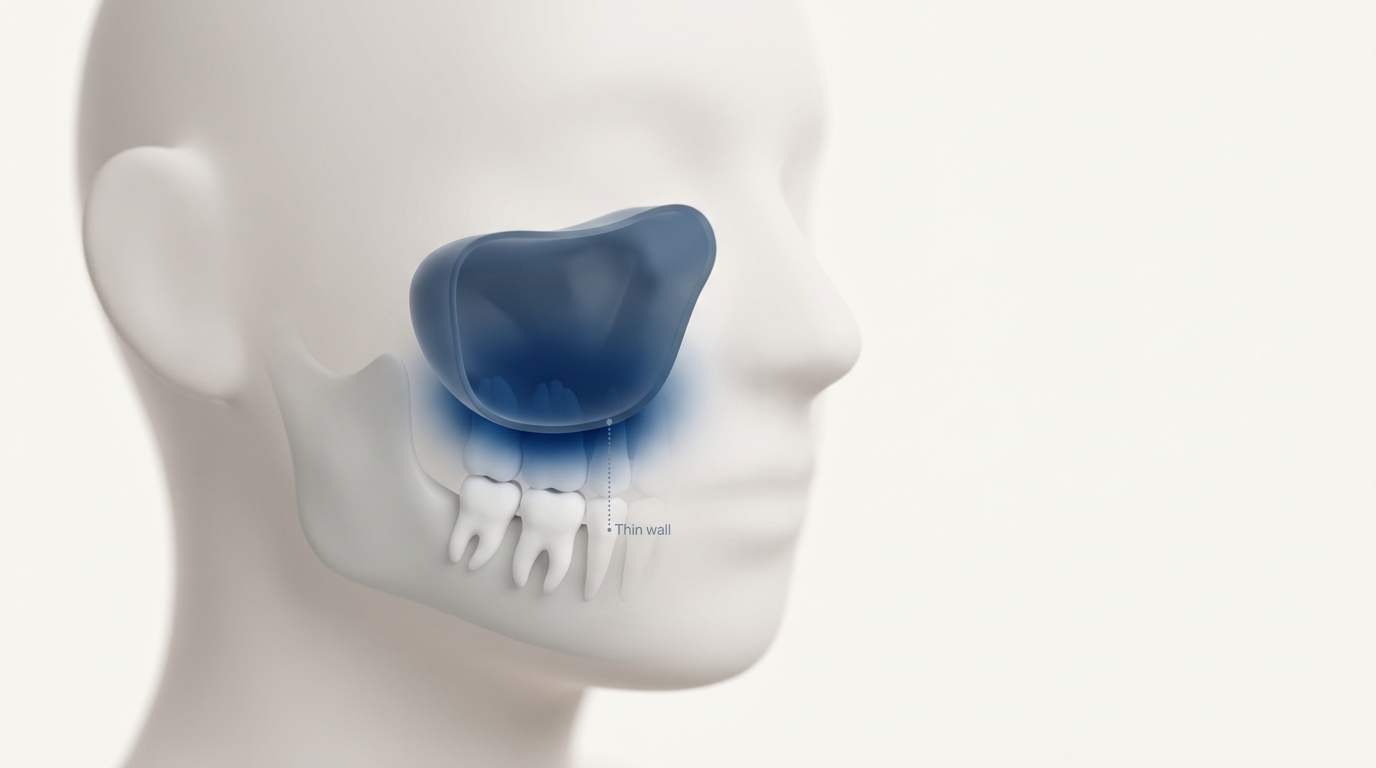
Non-Healing Mouth Sores: When to See an ENT vs. a Dentist
A mouth sore can be annoying, painful, and disruptive—especially when a mouth sore won’t heal. Most sores come from everyday problems like irritation, minor infections, or canker sores. The trick is knowing when “watch and wait” stops being a safe plan.
A helpful way to think about it: a lingering mouth sore is like a “check engine” light. It often turns out to be something fixable and local (like a sharp tooth edge), but if it stays on long enough, it deserves a professional look to rule out bigger issues.
This guide explains the “two-week rule mouth sore” principle, common causes of non-healing mouth sores, and how to decide whether to start with a dentist or consider an ENT (ear, nose, and throat specialist).

Quick Answer: Dentist or ENT for a Mouth Sore That Won’t Heal?
Use the “Two-Week Rule” (14 Days)
Many minor mouth ulcers improve within 7–14 days in most healthy individuals. If a sore doesn’t show signs of healing within two weeks, it should be evaluated to rule out less common but more serious causes (including oral cancer). This two-week guidance is widely referenced in clinical education and referral pathways.
- Cleveland Clinic (mouth ulcers): https://my.clevelandclinic.org/health/diseases/21766-mouth-ulcer
- Mouth Cancer Foundation (referral pathway): https://www.mouthcancerfoundation.org/referral-care-pathway/
“Shows signs of healing” can be subtle—less pain, smaller size, a smoother edge, or less redness. If you’re at day 14 and it looks basically the same, that’s the point of the rule: don’t keep guessing.
General rule of thumb
- Start with a dentist for most sores inside the mouth (gums, cheeks, lips, tongue).
- Consider an ENT (otolaryngologist) when symptoms involve the throat, voice box (larynx), or neck, or when a clinician feels a specialty head-and-neck evaluation is needed.
A simple example: a sore on the inner cheek rubbing against a broken filling is usually “dentist-first.” A sore sensation “down in the throat” with hoarseness or a neck lump is often “ENT-now.”
If you’re unsure, it can help to review general guidance on when to see an ENT and what symptoms fall into ENT “territory.”
- Internal resource: https://sleepandsinuscenters.com/when-should-i-see-an-ent
What Counts as a “Non-Healing Mouth Sore”?
People use different words to describe what they’re seeing or feeling. A “sore” might be:
- An ulcer (open spot)
- A red or white patch
- A blister cluster
- A crack at the corner of the lip
- A raised bump/lump
- A “raw” or “burning” area that keeps returning
It’s also common to notice something indirectly—like avoiding one side when chewing, switching to soft foods, or wincing when brushing a specific area—before you can even “see” the sore well.
What “not healing” can look like
A mouth ulcer not healing doesn’t always mean constant severe pain. It may look like:
- Pain that persists beyond two weeks
- A sore that doesn’t shrink, crust, or resolve
- A spot that reopens repeatedly
- Easy bleeding, thickened borders, or a firm “edge” to the lesion
Clinicians often focus on persistence and pattern. A sore that’s truly healing usually changes week to week. A sore that is stuck in place—or keeps returning in the exact same spot—deserves a closer look.
If a sore isn’t clearly improving by the two-week mark, it’s time to get it checked.
Symptoms Checklist (What to Track Before Your Visit)
Whether you see a dentist, primary care provider, or an ENT, a few notes can make the appointment more efficient.
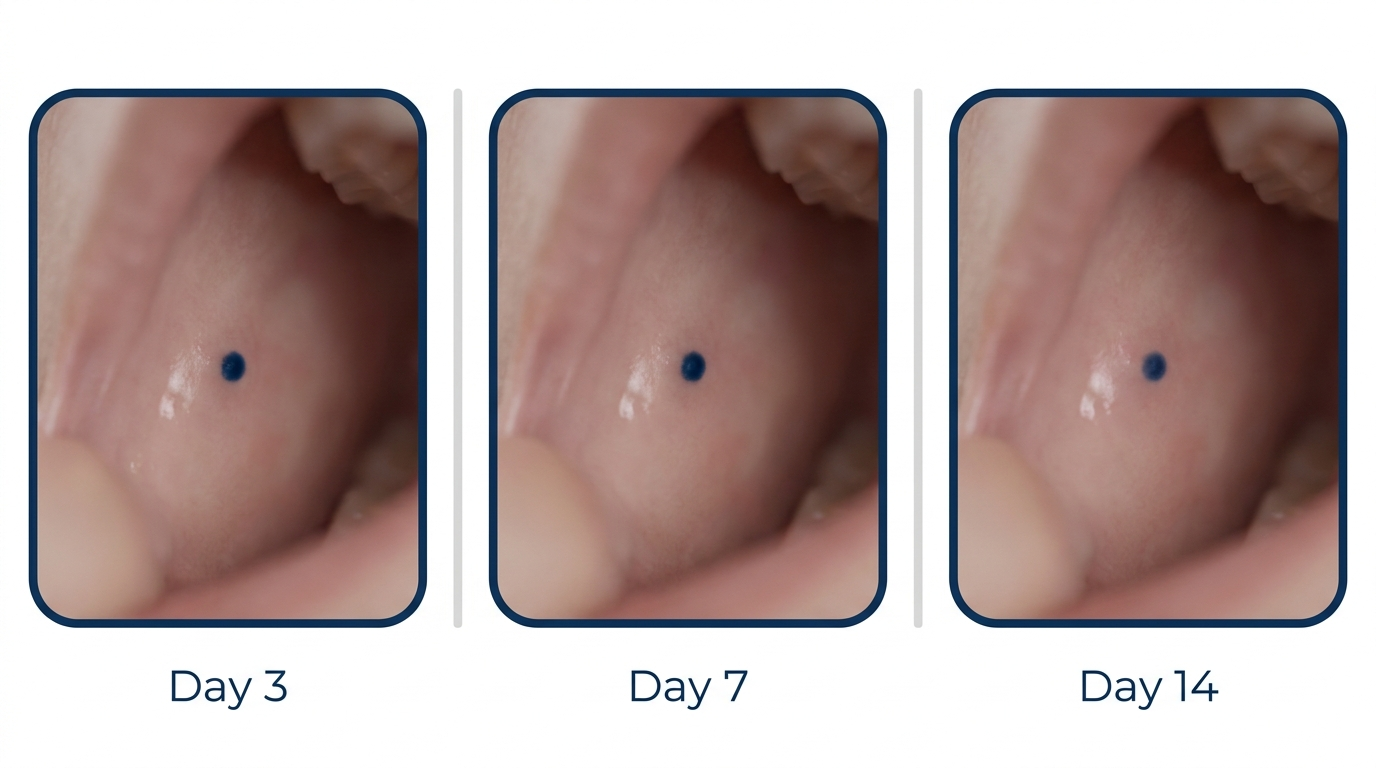
Think of this as giving your clinician a “timeline” instead of a snapshot. Mouth tissue can change quickly, and your description may fill in what the sore looked like on day 2 versus day 12.
Sore-specific details to write down
- Location: side/underside of tongue, gumline, cheek, floor of mouth, hard/soft palate, tonsil area
- Size and appearance: white/yellow center, red border, raised vs. flat, crusted vs. open
- Pain level and triggers: spicy/acidic foods, brushing, talking, swallowing
- Number of sores: single vs. multiple
- Timing: first time vs. recurring; how often; how long each episode lasts
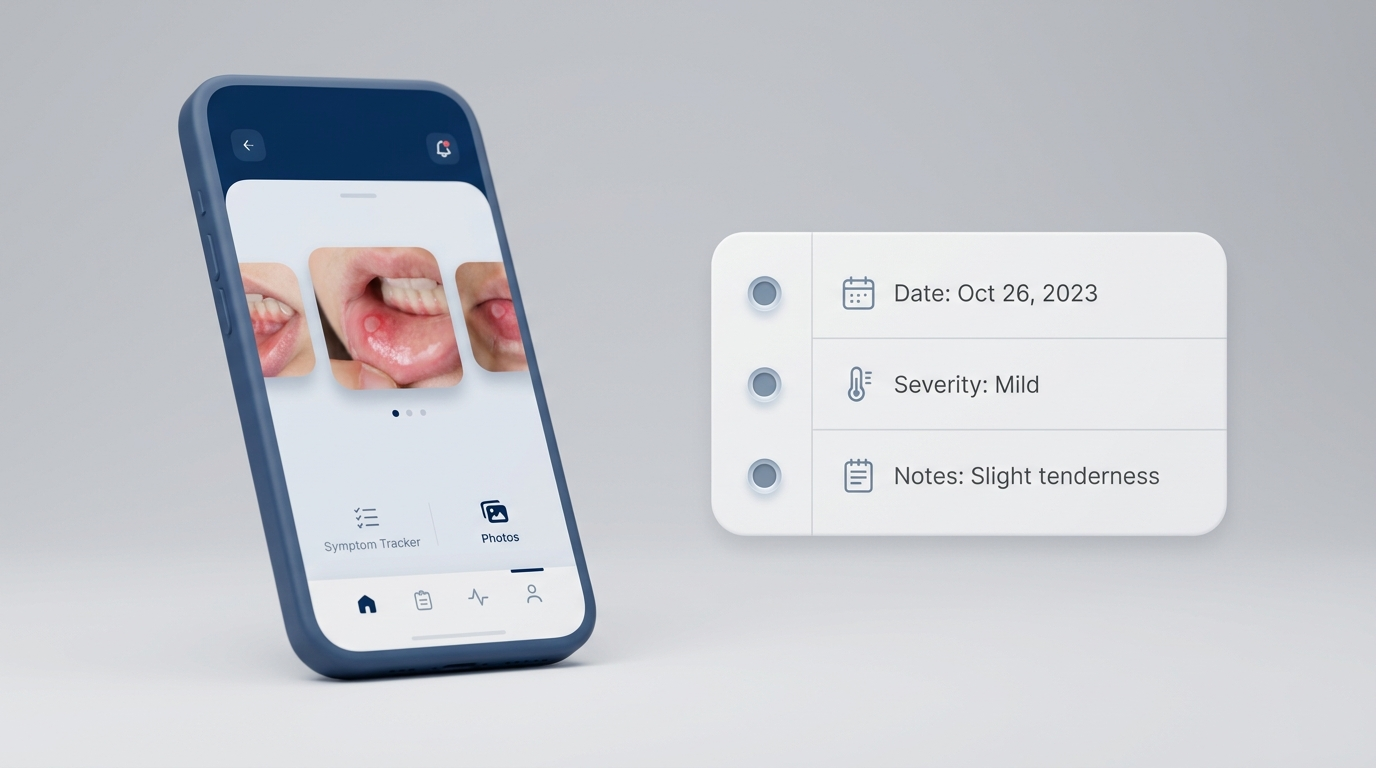
A practical tip: take one clear photo every few days (good lighting, same angle). That “progression” view can help your provider judge whether it’s truly changing.
Whole-body or “system” symptoms that matter
- Fever, fatigue, swollen glands
- Unintended weight loss
- New medications (including inhalers), recent illness, immune conditions
- Tobacco exposure and alcohol use history (important risk context for persistent lesions)
These details don’t diagnose the cause, but they help your clinician narrow the possibilities and choose the right next step (watchful recheck vs. testing vs. biopsy).
A short written timeline plus a few photos can speed up getting to the right answer.
Common Causes of Mouth Sores (Most Are Benign—But Don’t Guess)
Most mouth sores are not dangerous. The challenge is that non-healing mouth sores can look similar across many different causes, especially early on. Appearance alone doesn’t always tell the full story.
Irritation/trauma (very common)
- Cheek or lip biting
- Sharp tooth edge, broken filling, rough crown
- Denture/retainer friction, braces irritation
- Burns from hot foods
If the trigger remains (for example, a sharp edge), the sore may keep reopening—creating the impression that it “won’t heal.” A classic scenario is an ulcer right along the bite line that improves slightly, then flares again after meals or overnight clenching.
Canker sores (aphthous ulcers)
Often:
- Round/oval
- Shallow
- Painful
They can recur and may be influenced by stress, sleep disruption, and food sensitivities.
Viral, bacterial, and fungal infections
Examples include:
- Cold sores (HSV)
- Hand-foot-and-mouth disease
- Oral thrush (Candida), sometimes after antibiotics or inhaled steroids
Inflammatory/autoimmune conditions
Some conditions can cause persistent or recurring mouth lesions (diagnosis requires a clinician and sometimes biopsy). Examples often discussed include lichen planus and other inflammatory blistering disorders.
Nutritional deficiencies and systemic factors
Iron, B12, or folate deficiency, dry mouth, and immune suppression can contribute to recurring or slow-to-resolve sores. This doesn’t mean you should self-prescribe supplements; it means persistent sores sometimes warrant a broader look at overall health.
Oral cancer and precancerous lesions (why the two-week rule exists)
The two-week rule mouth sore guidance exists because persistent ulcers or patches can, in some cases, signal a precancerous or cancerous process. Concerning patterns can include a persistent ulcer, a firm lump, red/white patches, or unexplained bleeding. These signs alone don’t confirm a diagnosis—only a clinical exam and, if needed, a biopsy can.
- Cancer Research UK (referral): https://www.cancerresearchuk.org/about-cancer/mouth-cancer/getting-diagnosed/referral-specialist
- Mouth Cancer Foundation (pathway): https://www.mouthcancerfoundation.org/referral-care-pathway/
Most sores are benign, but persistence—not pain level—is the key reason to get evaluated.
When to See a Dentist First (Best First Step for Many Patients)
Dentists frequently serve as the first-line screen for mouth lesions. They commonly evaluate areas such as:
- Gums
- Inner cheeks
- Lips
- Front two-thirds of the tongue
- Floor of mouth
A dentist can often identify local factors (trauma points, dental infections, appliance irritation) and help decide whether monitoring, treatment, or referral for biopsy is appropriate. Only a biopsy and pathology report—not a visual exam alone—can definitively confirm or rule out cancer.
Examples that fit “dentist-first”
- A new sore after dental work, a new retainer, or denture adjustments
- A sore right next to a sharp tooth edge or broken filling
- Pain centered around one tooth with gum swelling
If your main issue is clearly dental (tooth pain, a cracked tooth, an ill-fitting dental appliance), starting with a dentist is often efficient. If the dentist doesn’t see a clear dental source—or the sore persists—they can document it and help direct you to the right specialist.
If a sore sits where your teeth or appliances rub, a dentist is usually the fastest first stop.
When to See an ENT (Otolaryngologist) Instead—or in Addition
Sometimes the location or associated symptoms suggest a head-and-neck evaluation rather than (or along with) a dental evaluation.
ENTs manage a broad range of throat and neck conditions and also coordinate care when a head-and-neck cancer concern arises. They examine the mouth, throat, voice box, and neck lymph nodes, and they’re often the right team when deeper areas need visualization.
Location-based reasons (ENT territory)
An ENT may be especially relevant when the sore/pain seems located in the:
- Back of the mouth, tonsils, or throat
- Base of tongue region (harder to visualize without specialized tools)
- Voice box (larynx) area, especially with hoarseness or voice change
- Or when there are neck symptoms
A concrete example: a patient may say, “I don’t see a sore, but it feels like something is stuck on one side when I swallow.” That’s often a scenario where throat-focused evaluation adds real value.
ENT is especially important if you have neck findings
A persistent swollen lymph node or a new neck lump deserves timely evaluation.
- Internal resource: https://sleepandsinuscenters.com/ent-help-for-swollen-lymph-nodes-in-the-neck
- General ENT guidance: https://sleepandsinuscenters.com/when-should-i-see-an-ent
- Cancer Research UK (referral): https://www.cancerresearchuk.org/about-cancer/mouth-cancer/getting-diagnosed/referral-specialist
If your symptoms involve the throat, voice, or neck, skip the guesswork and ask an ENT to take a look.

Red Flags: Get Urgent Evaluation (Same Day or Within 24–48 Hours)
From an educational standpoint, these symptoms are generally considered urgent because they can signal infection complications or more serious disease.
Ask yourself: “Is this affecting breathing, swallowing, hydration, or rapidly changing?” If yes, it’s safer to be seen quickly.
Symptoms that should not wait
- Worsening difficulty swallowing (dysphagia) or significant pain with swallowing
- Learn more: https://sleepandsinuscenters.com/blog/what-is-difficulty-swallowing-dysphagia
- Neck lump (new, enlarging, persistent, or asymmetric)
- Trouble breathing, drooling, or inability to swallow saliva
- A rapidly enlarging lesion, unusually large ulcer, or frequent recurrence
- Unexplained weight loss, persistent one-sided ear pain, or voice change
Sources:
- Mouth Cancer Foundation (pathway): https://www.mouthcancerfoundation.org/referral-care-pathway/
- Cancer Research UK (referral): https://www.cancerresearchuk.org/about-cancer/mouth-cancer/getting-diagnosed/referral-specialist
If breathing, swallowing, or hydration is at risk, seek care now.
What to Expect at the Appointment (Dentist vs. ENT)
What a dentist may do
- Oral exam of teeth, gums, tongue, cheeks, and palate
- Review of risk factors and recent triggers (including irritation sources)
- Check for sharp edges, failing dental work, or appliance friction
- Photos and measurements to document the lesion over time
- Recommendation for follow-up, referral, or biopsy if the spot persists or appears suspicious
You may hear a dentist say something like, “Let’s remove the irritant and re-check in two weeks,” or “This doesn’t look like a typical trauma ulcer—let’s refer you.” Both are reasonable, depending on what they see.
What an ENT may do
- Head and neck exam (including lymph nodes)
- Throat evaluation; sometimes a flexible scope exam to view deeper areas (base of tongue, throat, larynx)
- Imaging when indicated based on exam findings
- Biopsy or coordination of biopsy when appropriate—especially for throat/neck concerns
For many patients, the scope exam is the “missing piece” when the problem isn’t easily visible in the mirror—particularly for symptoms that feel deeper, lower, or one-sided.
Expect a careful look, documentation, and a clear plan for follow-up or testing if needed.
Treatment Options (Depends on the Cause)
Treatment depends on why the lesion is there, which is one reason guessing can be risky when a mouth sore won’t heal. The goals are to relieve symptoms and identify the underlying cause—especially when the sore is persistent.
At-home care for minor/early sores (while monitoring the two-week clock)
- Avoid spicy/acidic foods and alcohol-based mouthwash
- Saltwater rinses
- Gentle oral hygiene
- Over-the-counter topical products may help with comfort for minor sores—check with a pharmacist or your provider before use, especially for children or if you take other medications
(These measures may ease symptoms, but symptom improvement doesn’t confirm a diagnosis.)
Dentist-led treatments
Depending on the cause, a dentist may address:
- A sharp tooth edge or rough restoration
- Denture/retainer fit issues
- Local dental infections or gum inflammation
- Dry-mouth contributors and hygiene adjustments
Sometimes the “treatment” is simply removing the mechanical trigger—smoothing a sharp edge or adjusting an appliance—so the tissue can finally close and repair.
ENT-led or specialist treatments
When throat structures, neck findings, or suspicious lesions are involved, ENT-directed care may include:
- Targeted treatment for throat-based inflammation/infection
- Biopsy planning and coordination
- Referral pathways if a more complex workup is needed
Comfort care is fine early on, but persistence beyond two weeks should shift the focus to diagnosis.
Lifestyle Tips to Lower Your Risk of Recurrence (and Support Healing)
Reduce irritation and re-injury
- Address bite issues and sharp edges
- Use dental wax for braces
- Replace or adjust damaged dental work or appliances
Support the oral environment
- Stay hydrated and manage dry mouth triggers
- Avoid tobacco and limit alcohol (both are important risk factors for head and neck cancers)
Don’t self-diagnose persistent lesions
Even when discomfort improves, persistent or repeatedly returning lesions can still deserve evaluation—particularly with non-healing mouth sores that reach the two-week mark.
Fix what’s rubbing, support healing, and don’t ignore a sore that keeps coming back.
FAQs (Patient-Friendly, SEO-Rich)
How long should a mouth sore take to heal?
Many minor sores improve within 7–14 days in most healthy individuals. If a sore persists beyond two weeks, an evaluation is recommended to clarify the cause.
- Cleveland Clinic: https://my.clevelandclinic.org/health/diseases/21766-mouth-ulcer
Can a dentist diagnose oral cancer?
Dentists commonly screen for suspicious oral lesions and can identify findings that may need referral for specialist evaluation and/or biopsy. Only a biopsy and pathology report can confirm a diagnosis.
When is an ENT better than a dentist for mouth sores?
When symptoms involve the throat, voice box, or neck, or when a lesion requires deeper visualization or head-and-neck surgical evaluation.
- Internal resource: https://sleepandsinuscenters.com/when-should-i-see-an-ent
What does a biopsy involve?
A biopsy typically involves numbing the area, removing a small tissue sample, and sending it to a lab for pathology review. Turnaround time varies by lab and clinical setting.
What if the sore comes and goes?
Recurrent sores can still deserve evaluation—especially if they’re large, frequent, slow to resolve, or accompanied by systemic symptoms.
If you’re unsure where to start, ask your dentist or an ENT for direction based on location and symptoms.
When to Book an Appointment (CTA)
If it’s been two weeks and your mouth ulcer is not healing—or if you have any red-flag symptoms—it’s reasonable to schedule an evaluation to clarify the cause and next steps.
To request a visit with Sleep and Sinus Centers of Georgia, you can book an appointment here:
- https://sleepandsinuscenters.com/appointments
If you’re trying to decide between “dentist vs. ENT,” booking a medical evaluation can also help you get directed to the right next step quickly—especially for throat, voice, or neck symptoms.
Two weeks without improvement is your cue to get professional eyes on it.
References
- Cleveland Clinic. Mouth Ulcers. https://my.clevelandclinic.org/health/diseases/21766-mouth-ulcer
- Cancer Research UK. Mouth cancer referral to a specialist. https://www.cancerresearchuk.org/about-cancer/mouth-cancer/getting-diagnosed/referral-specialist
- Mouth Cancer Foundation. Referral & care pathway. https://www.mouthcancerfoundation.org/referral-care-pathway/
This article is for educational purposes only and is not medical advice. Please consult a qualified healthcare provider for diagnosis and treatment.
Don’t let allergies slow you down. Schedule a comprehensive ENT and allergy evaluation at Sleep and Sinus Centers of Georgia. We’re here to find your triggers and guide you toward lasting relief.